
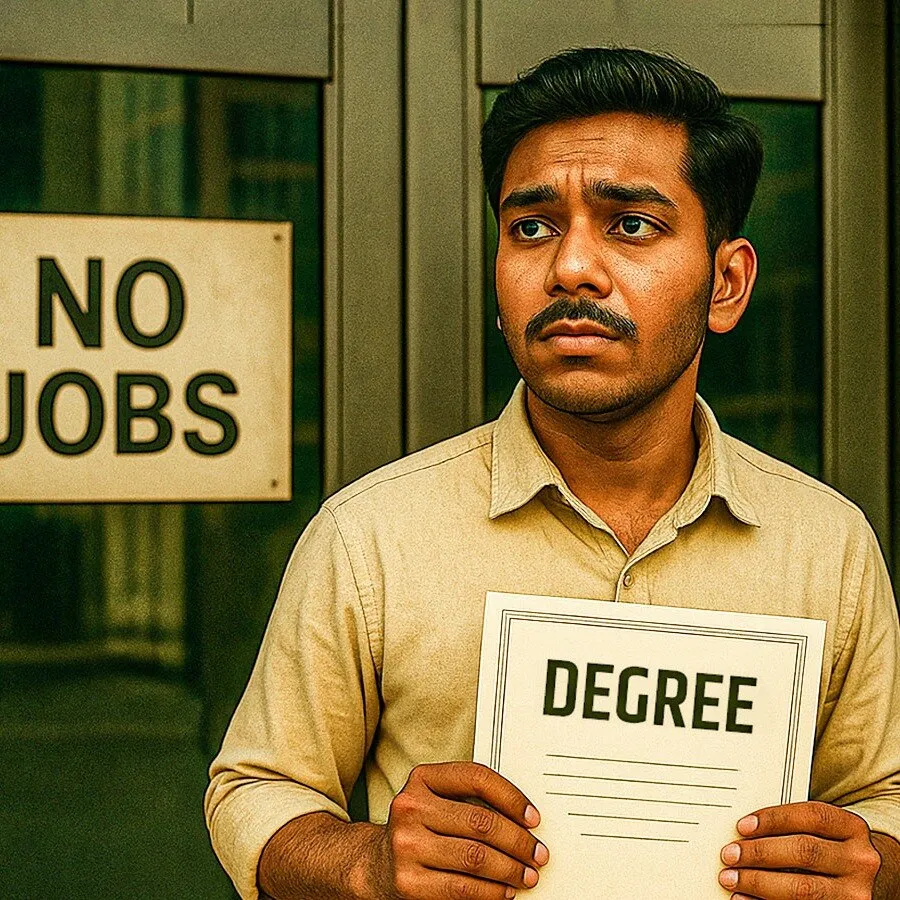
India is producing graduates in record numbers, yet a large share of them remain without suitable work. The paradox is clear: the more educated a young person becomes, the higher the chance of facing unemployment or underemployment. Behind official statistics lie years of preparation, repeated applications, coaching classes and delayed entry into the workforce. Being qualified no longer guarantees employment that matches the qualification.
The Scale of Educated Unemployment
Recent labour data reveal a striking inversion of the usual pattern. National unemployment rates remain relatively low, yet unemployment among graduates stands several times higher. Reports place graduate unemployment around 13 percent overall and above 20 percent for women graduates, compared with a national rate near 3 percent. Among the youngest graduates, the figures are even more severe: nearly 40 percent of those under 25 and about 20 percent of those aged 25 to 29 are without jobs.
Youth unemployment as a whole has been recorded in the mid-teens in recent monthly surveys, with urban rates higher still. Two out of every three unemployed young people now hold a degree, a complete reversal from earlier decades when the less educated formed the bulk of the jobless. India adds roughly five million graduates each year, but only about 2.8 million find any form of work annually, and a far smaller share secure stable salaried positions within the first year.
The Qualification–Job Mismatch
One of the most revealing findings is that only a small fraction of graduates—around 8.25 percent—work in roles aligned with their field of study. The vast majority end up in positions unrelated to their degrees. This points to a structural disconnect between what is taught and what the labour market demands.
A large proportion of students enrol in general undergraduate programmes such as BA, BSc and BCom. Combined enrolment in these streams exceeds two crore, with BA alone accounting for more than one crore students. Many pursue these degrees primarily to remain eligible for government examinations or to meet basic family expectations of higher education. The result is a large pool of credentialed youth competing for a limited number of formal roles that do not necessarily require the specific knowledge gained in those programmes.
Employers consistently report that a majority of undergraduate and business-school curricula are not aligned with current industry needs. Practical exposure, internships and applied skills remain limited for many students. In hiring decisions, demonstrated abilities in areas such as data, artificial intelligence or cybersecurity increasingly outweigh the prestige of a particular college.
Waiting, Aspirations and the Informal Alternative
Educated youth often engage in what researchers describe as “waiting unemployment.” Rather than accepting informal, gig or low-skilled work below their perceived qualification level, many hold out for formal salaried jobs or success in competitive examinations. This behaviour is rational at the individual level—families invest heavily in education and expect returns—but creates a large cohort of young people who appear idle in the data even while preparing for exams or searching for preferred roles.
When they eventually enter the workforce, a significant share move into informal employment or unpaid family work. The transition from education to stable, quality employment remains weak. Only a small percentage secure regular salaried positions within a year of graduating. The rest cycle through applications, short-term contracts or periods of inactivity.
Structural Drivers Behind the Gap
Several interlocking factors sustain the problem. Economic growth has been more capital-intensive than employment-intensive in recent years, generating fewer quality jobs relative to the number of educated entrants. The education system continues to emphasise theoretical knowledge and examination performance over practical, industry-linked skills. Information gaps persist: many students and families lack clear guidance on which programmes or skills lead to better employment outcomes.
Gender differences add another layer. Female graduates face higher unemployment rates, and a large share of tertiary-educated young women remain outside the labour force entirely. Social norms, safety concerns and limited flexible work options continue to constrain their participation even after significant educational investment.
Automation and technological change further complicate the picture. Roles that once absorbed general graduates are evolving or disappearing, while new opportunities demand specialised or continuously updated skills that many curricula have not yet incorporated.
The Human and Economic Cost
For individuals and families, prolonged joblessness after graduation brings financial strain, delayed independence and psychological pressure. Years spent in coaching centres or repeated applications represent both direct costs and opportunity costs. At the societal level, a large educated but underutilised youth population limits the realisation of India’s demographic dividend. Productive potential remains untapped while social frustration can grow.
The problem is not that education lacks value. Educated workers still command higher earnings on average once employed, and education delivers broader social benefits. The difficulty lies in the weak bridge between classroom and workplace and in the insufficient creation of roles that match rising aspirations and qualifications.
Pathways Toward Better Alignment
Addressing the gap requires action on multiple fronts. Higher education needs stronger industry linkages, updated curricula, mandatory internships and work-integrated learning. Expanding apprenticeships and recognising skills alongside degrees can improve transitions. Employers themselves have a role in investing in early-career training rather than expecting fully job-ready candidates at entry level.
Guidance systems that help students choose programmes with clearer labour-market pathways, combined with greater transparency about employment outcomes of different courses, would reduce the prestige-driven rush into generic degrees. Policies that support quality job creation in labour-intensive and emerging sectors remain essential.
For young people currently navigating the system, continuous skill-building, practical experience and realistic assessment of opportunities can improve individual chances even while structural reforms take time.
A Challenge That Demands Collective Response
India’s educated youth are not lacking in ambition or effort. They prepare for years, acquire credentials and apply persistently. The difficulty is that the volume of qualifications has outpaced the volume of matching opportunities, and the content of many qualifications has drifted from the needs of employers. Closing this gap is central to converting demographic potential into sustained economic and social gains. Until education, skills and employment opportunities move into closer alignment, the experience of being qualified yet jobless will remain a defining reality for too many of the country’s young people.
Read more – Instantdua.com
