
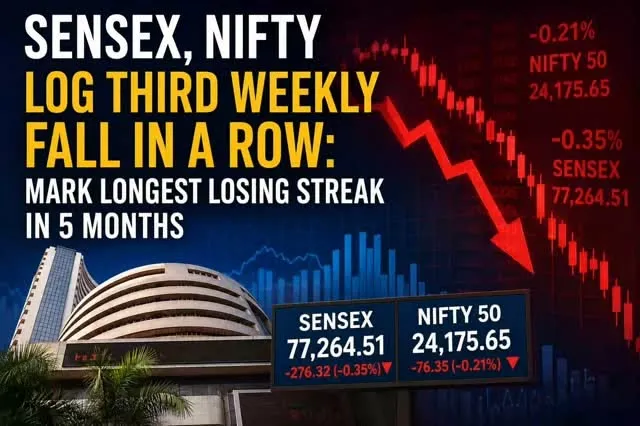
Indian equity benchmarks opened lower and remained under pressure as rising crude oil prices, weakness in information technology stocks and escalating tensions in West Asia weighed on investor sentiment. Early trade figures showed the BSE Sensex down more than 400 points and the Nifty 50 trading below the 23,700 mark, reflecting a cautious start driven by global risk factors.
Opening Levels and Market Tone
In early trading, the Sensex was down around 402 points, or 0.53 per cent, near 75,731. The index had opened lower against the previous close near 76,133. The Nifty 50 declined by roughly 108 points, or 0.45 per cent, to trade around 23,671. The broader market also reflected selective selling, with several heavyweight stocks contributing to the decline.
The session continued a recent phase of caution on Dalal Street. Investors remained focused on external developments rather than domestic corporate or economic data, leading to a risk-off mood across major indices.
Crude Oil Surge Raises Inflation Concerns
The sharp rise in global crude prices emerged as one of the primary triggers for the market weakness. Brent crude traded near the $97–$98 per barrel zone, levels that have not been seen in recent weeks. The move was driven by heightened geopolitical tensions in West Asia, particularly around the Strait of Hormuz, a critical corridor for global oil shipments.
For India, which imports a large majority of its crude requirements, elevated oil prices raise concerns on multiple fronts. Higher energy costs can push up the import bill, add to inflationary pressures and increase input costs for companies across sectors. Markets are sensitive to any sustained rise in crude because it can influence the trajectory of monetary policy and corporate margins.
West Asia Tensions Weigh on Sentiment
Renewed friction between the United States and Iran kept risk appetite subdued. Reports of strikes involving vessels and warnings of further retaliation contributed to fears of potential supply disruptions. Any prolonged uncertainty around energy flows from the region tends to support higher oil prices and prompt investors to reduce exposure to risk assets, including emerging-market equities.
Indian markets have historically reacted to such developments because of the direct link between oil prices, the current account and domestic inflation. The latest escalation reinforced the cautious stance among both domestic and foreign participants.
IT Stocks Lead the Decline
Information technology shares were among the major drags on the benchmarks. The sector faced pressure amid renewed expectations of tighter monetary policy in the United States. Stronger-than-anticipated US employment data had revived speculation that the Federal Reserve could maintain a firmer stance on interest rates.
Higher US rates typically strengthen the dollar and reduce the relative attractiveness of emerging-market assets. IT companies, which derive a significant portion of their revenues from the US market, often come under selling pressure in such an environment. Stocks including Infosys and other large technology names were among the notable losers in early trade, contributing to the overall market decline.
Broader Market and Sector Trends
Selling was visible across several segments beyond IT. Realty, metals and select financial stocks also faced pressure in early dealings. Defensive pockets and a few infrastructure or telecom names occasionally provided limited support, but the overall tone remained negative.
Foreign institutional investor activity has added to the cautious environment in recent sessions, with outflows reflecting global risk aversion. Domestic institutional buying has offered some cushion in previous days, yet it has not been sufficient to fully offset the impact of higher oil prices and geopolitical worries.
Why These Factors Matter Together
The combination of rising crude, West Asia tensions and US rate uncertainty creates a challenging backdrop for Indian equities. Higher oil prices feed into inflation concerns. Geopolitical risks keep global investors defensive. Expectations of firmer US policy reduce liquidity flows into emerging markets. When these elements coincide, benchmark indices often struggle to hold higher levels even if domestic fundamentals remain relatively stable.
Analysts have noted that the market has been in a corrective phase for several weeks. While corporate earnings and economic activity have shown resilience in parts of the economy, external headwinds have dominated near-term sentiment.
What Investors Are Watching
Market participants are closely tracking developments on three fronts. First, any further movement in crude oil prices and signs of de-escalation or intensification in West Asia will remain critical. Second, upcoming US economic data and Federal Reserve commentary will influence the outlook for global interest rates. Third, domestic institutional flows and the performance of heavyweight stocks will determine whether the broader market can stabilise.
Technical levels are also under scrutiny. A sustained move back above key resistance zones on the Nifty would be needed to restore short-term confidence, while a deeper break lower could extend the ongoing consolidation.
Outlook Remains Cautious
The early decline in the Sensex and Nifty underscores the sensitivity of Indian markets to global energy and geopolitical developments. With crude oil hovering near multi-week highs and tensions in West Asia unresolved, investors are likely to remain selective. IT stocks may continue to face pressure if US rate expectations stay elevated, while sectors more directly linked to input costs could also remain volatile.
In the near term, markets are expected to trade with a cautious bias until clearer signals emerge on oil prices and global monetary policy. For now, the combination of higher crude and external uncertainties has kept risk appetite in check and placed both the Sensex and Nifty under pressure at the start of the session.
Read more – tastymenuideas.com
