
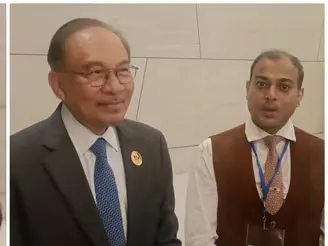
Diplomacy rarely unfolds to the sound of a piano. Yet on the sidelines of the BRICS Summit in New Delhi, a quiet evening in a hotel lobby produced one of the most shared cultural moments of the gathering. Malaysian Prime Minister Anwar Ibrahim paused, smiled and began singing classic Hindi film songs while Delhi-based pianist Mujeeb ur Rehman accompanied him. The video, later posted by the Prime Minister himself, quickly travelled across social media and turned an ordinary working evening into an international talking point.
A Moment Prepared in Advance
The encounter was not pure chance. Hotel management at Le Meridien had informed Rehman that the Malaysian leader, known to enjoy Hindi songs, might pass through the lobby during his stay for the summit. Rehman, who normally begins playing around 5 or 5:30 pm, started earlier during the summit days so he would not miss the opportunity.
He did his homework. A quick search told him that Anwar Ibrahim particularly liked two songs: “Dost Dost Na Raha” from the 1964 film Sangam and “Khwab Ho Tum Ya Koi Haqeeqat” from the 1965 film Teen Deviyan. When he spotted the Prime Minister approaching on the evening of September 12, Rehman moved to the piano, opened it and began playing “Dost Dost Na Raha” a little louder than usual, hoping to catch his attention.
It worked. Ibrahim stopped, smiled and started singing along. He then requested the second song. Rehman, relieved that he knew it, continued playing as the Prime Minister sang. The short performance, captured on video and shared by Ibrahim with the light-hearted caption asking permission to sing for a moment, resonated far beyond the hotel.
From Traditional Roots to the Piano
Rehman’s path to that piano was shaped by a family steeped in classical and traditional Indian music. His elder brother played the sitar. His father played the dilruba. His maternal uncle was a celebrated sitarist, and his maternal grandfather had been associated with the Song and Drama Division. Music filled the household, but it was largely traditional in form.
Rehman chose a different instrument. The piano, a Western import, did not fit neatly into the musical world around him. His family was not particularly supportive of the decision, and his father discouraged the pursuit. Undeterred, Rehman continued. When he first began learning, he assumed professional piano work would mean Western and English repertoire. Hindi film music was not part of his original plan. He kept playing it partly to satisfy his father, and that dual ability later proved valuable.
His professional journey began in 2004 at The Ashok hotel after persistent visits and an audition. Since then he has built a career through hotel residencies, freelance work and private performances. He currently plays lunchtime sets at Kwality Restaurant in Connaught Place and evening sets at Le Meridien. More than two decades into the profession, he still speaks with humility about how much music remains to learn, while expressing gratitude that the request that evening was for a song he knew.
The Songs That Bridged the Moment
The two melodies chosen carried their own cultural weight. “Dost Dost Na Raha,” rendered by Mukesh, is a sombre reflection on friendship from Raj Kapoor’s Sangam. “Khwab Ho Tum Ya Koi Haqeeqat,” sung by Kishore Kumar and composed by S.D. Burman with lyrics by Majrooh Sultanpuri, is a romantic classic from Dev Anand’s Teen Deviyan. Anwar Ibrahim’s clear and confident delivery of the Hindi lyrics impressed Rehman, who later described the leader as humble and gracious.
The Malaysian Prime Minister has previously shown appreciation for Hindi film music, including during earlier visits to India. The BRICS-side performance added an informal, human note to a formal diplomatic calendar and was widely received as a gesture of cultural warmth.
Visibility After Years of Steady Work
For Rehman, the viral attention brought an unfamiliar kind of recognition. People began identifying him in public. He expressed simple happiness that his face was being seen around the world after years of regular hotel performances that rarely place the musician at the centre of the story. The video’s rapid spread also meant his family saw it before he could even request a copy from the hotel.
The episode highlights the quiet professionalism of working musicians who perform in public spaces night after night. Preparation, presence of mind and a readiness to seize a brief window of opportunity turned a routine shift into a memorable cross-cultural exchange.
Music as Soft Connection
In the broader setting of a major multilateral summit, the moment served as a reminder that cultural familiarity can create unexpected bridges. A Malaysian leader singing well-known Hindi film songs with a Delhi pianist offered a light, human counterpoint to official discussions. It required no formal programme or stage—only a shared appreciation for melody and a pianist prepared for the possibility.
Rehman’s story also illustrates the value of versatility. Growing up surrounded by traditional instruments, he nevertheless mastered the piano and retained a working knowledge of Hindi film repertoire. That combination allowed him to meet the moment when it arrived. His persistence in securing early professional opportunities and his long-term commitment to hotel and restaurant residencies provided the platform from which the viral encounter became possible.
A Lasting Personal Memory
Looking back, Rehman recalls the nervousness of hoping the requested song would be one he knew, the relief when it was, and the genuine pleasure of the interaction. For a musician whose work is usually background to other people’s evenings, the experience of being fully seen—and of contributing to a moment that travelled far beyond the lobby—carries special meaning.
The video will eventually fade from daily feeds, but the story behind it endures: a pianist from a traditional musical family who chose an unexpected instrument, prepared quietly for a possible encounter, and found himself accompanying a world leader in a shared appreciation of classic Hindi film songs. In an era of carefully managed summits, it was an unscripted reminder of how music can still create spontaneous connection.
Read more – blessandseemusic.com
