
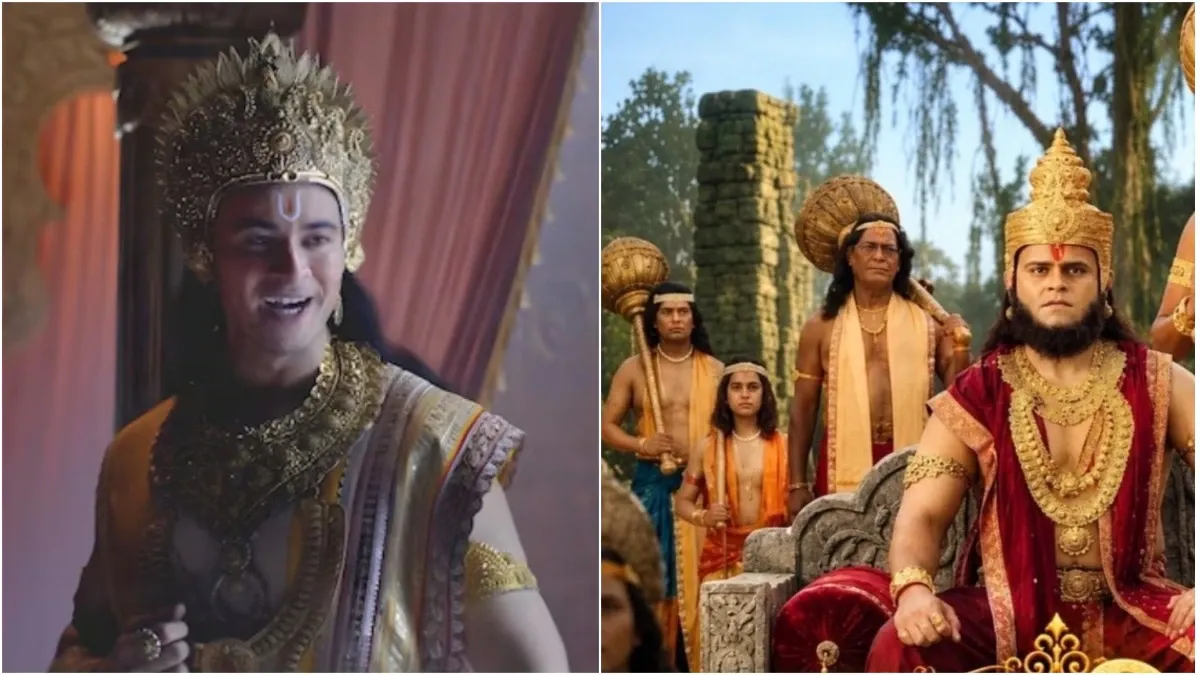
A promotional image from Mahakavya Shri Ramayan Katha – Shri Ram Ki showing a vanar character wearing spectacles has circulated widely on social media, prompting jokes, memes and criticism about historical accuracy in a story set in the Treta Yuga. The film’s makers have now responded, clarifying that the image is promotional artwork and not a scene from the theatrical version. They have urged audiences to experience the film itself before forming final opinions.
What Sparked the Online Reaction
The film, which released in theatres on September 25, 2026, stars Dev Sharma as Shri Ram, Anjali Arora as Mata Sita and Rajniesh Duggal as Ravan. Ahead of and around the release, the makers shared character posters. In one poster introducing Sugriv, a background figure among the vanar sena appears to be wearing modern spectacles.
The detail quickly became the focus of online commentary. Users questioned the presence of contemporary eyewear in a narrative rooted in the Treta Yuga. Comments ranged from humorous observations about “chashma in Treta Yug” to sharper criticism of production standards and attention to period detail. The image added to existing online discussion around the film’s casting, visual effects and overall presentation.
The Makers’ Clarification
Responding to the growing criticism, the team behind the film stated that the viral image is promotional artwork and does not represent a frame from the finished theatrical film. They challenged those circulating the image as evidence of a cinematic error to produce a genuine screenshot taken inside a cinema hall if the visual actually appears in the movie.
The response frames the controversy as a case of promotional material being misread as footage from the film itself. By drawing a clear distinction between marketing visuals and the theatrical cut, the makers have attempted to shift the discussion back toward the work as it exists on screen.
Actor Anjali Arora and the broader team have also appealed to viewers to watch the film in theatres before passing judgement. Their position is that social media fragments and isolated images do not constitute a full or fair assessment of the project.
Context of the Film’s Reception
Mahakavya Shri Ramayan Katha is a bilingual production in Hindi and Chhattisgarhi, directed by Abhishek Singh and produced by Prakash Mahobiya and Sanjay Bundela. From the release of its first teaser and poster, the film attracted attention for its casting choices and visual approach. Anjali Arora’s selection as Mata Sita, in particular, generated significant online debate, with some users questioning the decision and others defending the opportunity given to a newer face.
The spectacles image arrived against this backdrop of already heightened scrutiny. In an era when promotional stills and posters are examined frame by frame, even minor background details can become major talking points. The speed with which the image spread illustrates how quickly visual anomalies—or perceived anomalies—travel on social platforms.
Promotional Material Versus Finished Film
The distinction the makers have emphasised is important in contemporary film marketing. Posters, character introductions and social media artwork are often created or adjusted separately from the final edit. Background artists, composite images and last-minute design choices can introduce elements that do not appear in the theatrical version. When such material is treated as evidence of what audiences will see on screen, confusion and criticism can follow.
By inviting critics to verify the presence of the spectacles inside actual cinema screenings, the team has placed the burden of proof on those making the claim. Whether the clarification fully satisfies online sceptics remains to be seen, but it establishes an official position: the image in question is not from the film as released.
Larger Questions About Adaptation and Scrutiny
Any cinematic retelling of the Ramayana enters a space of high cultural sensitivity. Audiences bring deep familiarity with the epic, strong expectations about visual and emotional tone, and a readiness to compare new versions with earlier ones. In that environment, every casting decision, costume choice and background detail is subject to examination.
At the same time, the intensity of reaction to a single background element in a promotional poster raises questions about proportion. Social media rewards rapid, high-emotion responses. A pair of spectacles on a secondary figure can generate more immediate traction than sustained discussion of performance, narrative choices or thematic intent. Filmmakers working with limited resources or outside the biggest studio systems often face particularly sharp scrutiny when their work is measured against high-budget expectations.
The makers’ call to watch the film before judging is an attempt to restore sequence: experience first, evaluation second. Whether audiences accept that invitation will determine how much of the online conversation eventually engages with the film itself rather than its marketing materials.
Moving Forward
Mahakavya Shri Ramayan Katha is now playing in theatres. The viral spectacles image has become one of the most visible elements of its early public reception. The makers have addressed it directly, labelling the visual as promotional artwork, challenging the claim that it appears in the theatrical version, and asking viewers to base their opinions on the completed film.
In an information environment where images travel faster than context, such clarifications are increasingly necessary. The episode serves as a reminder that promotional material and finished cinema are not always identical, and that the most reliable way to assess a film remains the straightforward act of watching it.
Read more – Trubondlife.com
