
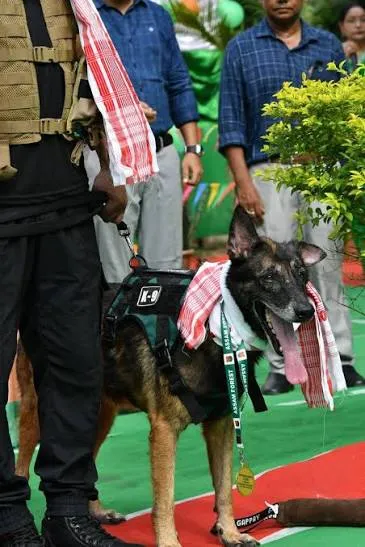
For nearly eight years, a Belgian Malinois named Leon served as one of Assam’s most reliable partners in the fight against wildlife crime. Known among forest and police teams as a “super sniffer,” K9 Leon tracked suspects through flooded forests, helped recover critical evidence, and even assisted in a town theft case far from the grasslands of Kaziranga. On 15 August 2026, he retired from active duty with official recognition of a career defined by endurance, discipline and an extraordinary nose.
Early Training and Entry into Service
Leon completed a specialised 12-month training programme focused on scent tracking and anti-poaching work before joining field duty in November 2018. He became part of the K9 Sniffer Dog Squad associated with the conservation organisation Aaranyak and was assigned to support the Assam Forest Department and state police in and around protected areas, particularly Kaziranga National Park and Tiger Reserve.
Belgian Malinois are valued for their agility, sharp instincts and strong work drive. Leon displayed these qualities consistently across more than 200 patrols and over 30 specialised tactical operations. His handlers, Anil Kumar Das and Mrigen Das, worked alongside him through demanding conditions that included extreme weather, riverine terrain and long hours in the field.
The 20-Kilometre Trail
The operation that most clearly defined Leon’s reputation took place during the severe floods of 2019. A suspected rhino poacher had moved through the landscape, leaving a scent trail that conventional tracking methods struggled to follow once footprints disappeared and water covered the ground. Leon picked up the scent and stayed on it for nearly 20 kilometres.
The trail led past several forest camps and security checkpoints. Despite the challenging conditions created by the floods, the dog maintained focus and guided personnel to the point where the suspect could be identified and apprehended. The successful tracking demonstrated both physical stamina and the reliability of scent work when visual clues had been erased by water and weather.
Further Contributions to Anti-Poaching Efforts
Leon’s work extended beyond that single high-profile chase. In 2023, forest personnel discovered a deer carcass at Bokakhat, the administrative headquarters of Kaziranga National Park, and suspected poaching. Leon was brought to the site. He led teams to incriminating evidence and helped track down four suspects who were subsequently apprehended.
Such cases illustrate the practical value of trained detection dogs in protected areas. When human trackers face washed-out trails, dense vegetation or large search areas, a dog’s ability to follow a specific scent can narrow the investigation rapidly and increase the chances of securing both evidence and suspects.
Work Beyond the Forest
Leon’s skills proved useful outside wildlife crime as well. In 2025, Assam Police sought his assistance in a gold theft investigation in Golaghat town. Once again relying on scent, Leon helped investigators identify and arrest four people connected to the case. The assignment showed that the same capabilities developed for anti-poaching work could transfer effectively to other criminal investigations when conventional leads were limited.
The versatility added another dimension to his service record. While his primary role remained the protection of Kaziranga’s fauna, particularly its rhinos, the ability to support police work in nearby towns expanded the practical impact of the K9 programme.
Recognition and Retirement
On Independence Day 2026, the Forest Department and police formally retired Leon with official honours. After nearly eight years of continuous field service, he was handed back to Aaranyak, the organisation that had originally provided him to the park. Officials noted that he would receive proper care in retirement.
Those who worked with him described a dog that maintained discipline and loyalty through difficult operational conditions. Aaranyak’s leadership highlighted the lasting contribution of the trails he followed and the cases he helped resolve, describing his service as part of the broader conservation effort in Assam.
Kaziranga continues to deploy other Belgian Malinois provided through the same programme, reflecting the established role of detection dogs in the state’s protected areas. Manas, Pobitora, Orang and other reserves also maintain similar capacity.
The Quiet Effectiveness of Scent Work
Leon’s career offers a clear example of how specialised working dogs complement human efforts in wildlife protection. Poaching investigations often begin with limited physical evidence. Rain, flooding and the sheer scale of forested landscapes can erase tracks within hours. A dog trained to follow a specific human scent can reopen an investigation that might otherwise stall.
The 20-kilometre pursuit during the 2019 floods remains the most dramatic illustration of that capability. Yet the cumulative value of more than 200 patrols and dozens of operations lies equally in the quieter, routine deployments that deterred crime or recovered evidence before cases escalated.
A Career Measured in Trails
K9 Leon leaves active service with a record built on persistence rather than spectacle. He followed scents when other methods failed, supported both forest and police teams, and worked through conditions that tested endurance as much as instinct. From the flooded forests of Kaziranga to a gold theft investigation in Golaghat, his nose helped close cases that protected both wildlife and the wider community.
As he begins retirement under the care of the organisation that trained and deployed him, the teams he supported retain the benefit of the methods and experience his service helped reinforce. In the ongoing effort to safeguard Assam’s protected areas, the contribution of one highly trained Belgian Malinois stands as a practical reminder of what focused partnership between handlers, dogs and frontline personnel can achieve.
Read more – Instantdua.com
