
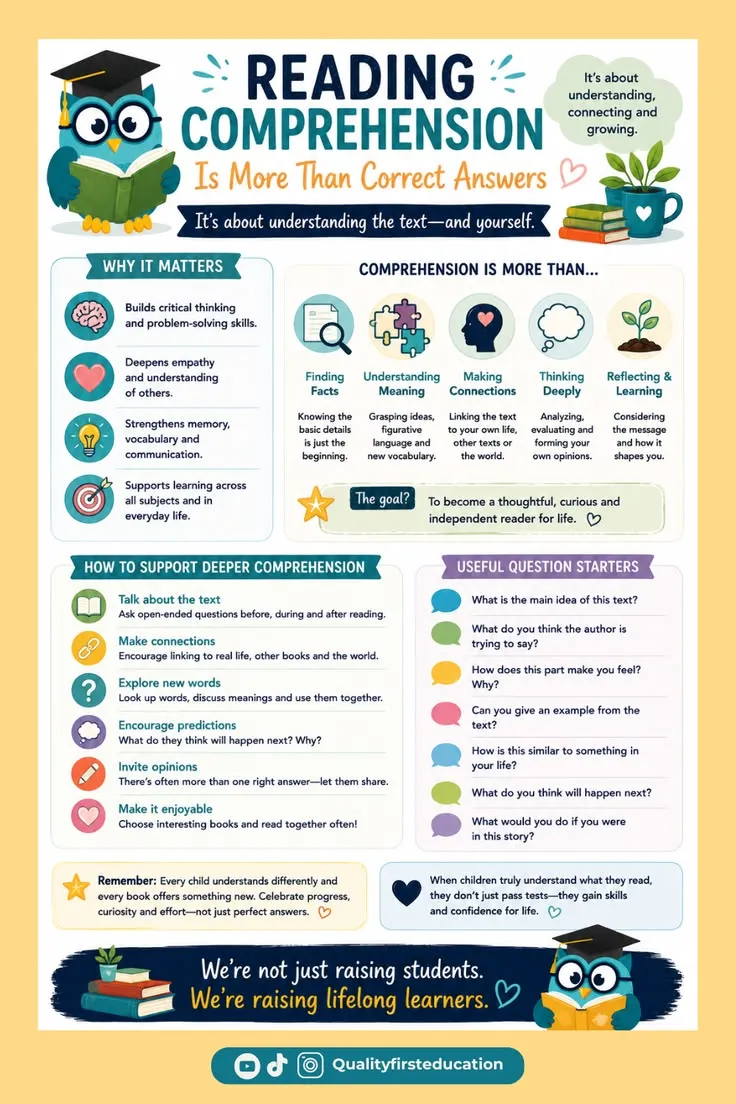
Reading comprehension is the ability to understand, interpret, and retain the meaning of written text. Many beginners struggle not because they cannot decode words, but because they read passively—moving their eyes across the page without actively constructing meaning. The good news is that comprehension is a skill that improves rapidly with deliberate practice. Evidence-based strategies used by skilled readers can be learned and applied by anyone willing to slow down, engage with the text, and monitor their own understanding.
Why Comprehension Matters and Why It Improves Quickly
Strong comprehension supports learning in every subject, professional growth, and everyday decision-making. Research shows that teaching specific strategies produces measurable gains, sometimes within weeks, because these techniques mirror what expert readers do automatically. The key is shifting from passive reading to active processing: predicting, questioning, clarifying, connecting, and summarizing as you go.
Beginners often see the fastest progress when they focus on a few high-impact habits rather than trying to master everything at once.
Activate What You Already Know
Before opening a text, take a moment to recall anything related to the topic. Ask yourself what you already know, what experiences you have had, or what questions the subject raises. This simple step creates mental “hooks” that help new information stick. When background knowledge is limited, briefly researching key terms or looking at related images can provide the necessary context.
Skilled readers constantly link new material to existing knowledge. Beginners who deliberately activate prior knowledge before reading understand and remember more of what follows.
Preview the Text and Set a Purpose
Never dive straight into dense paragraphs. Spend one or two minutes surveying the material: read the title, headings, subheadings, captions, bold or italicized words, and any summaries or questions at the end. This overview creates a mental map of the structure and main ideas.
Next, turn headings into questions. If a section is titled “Causes of the Industrial Revolution,” ask “What caused the Industrial Revolution?” Setting a clear purpose focuses attention and turns reading into a search for answers rather than a passive activity.
Read Actively and Monitor Understanding
As you read, pause frequently to check comprehension. Ask: “Do I understand this?” If the answer is no, use fix-up strategies immediately—reread the sentence or paragraph, slow down, look up an unfamiliar word, or read ahead a few lines for context. This habit of monitoring prevents the common problem of reaching the end of a page with almost no recollection of its content.
Annotation supports active reading. Instead of highlighting entire sentences, jot brief notes in the margin: a key point in your own words, a question, or a connection to something you already know. Writing forces deeper processing and creates a personal record of the text’s meaning.
Use the Power of Questioning and Visualizing
Good readers generate questions while they read. These can be simple (Who? What? When?) or more analytical (Why did this happen? How does this connect to earlier points?). Answering your own questions strengthens recall and critical thinking.
Visualization is equally powerful. Try to form mental pictures of scenes, processes, or relationships described in the text. Turning abstract language into concrete images makes ideas more memorable and easier to grasp, especially in narrative or descriptive material.
Clarify Vocabulary and Difficult Passages
Unknown words are a major barrier to comprehension. When you encounter an unfamiliar term, first try to infer its meaning from surrounding sentences. If that fails, look it up and note a simple definition or synonym. Pre-learning a few critical vocabulary words before reading a challenging text also reduces friction.
For complex sentences or paragraphs, pause and restate the idea in simpler language. Paraphrasing is one of the most effective ways to confirm understanding and transfer information into long-term memory.
Summarize Regularly
After each section or chapter, close the book or look away and summarize the main points in your own words. Keep the summary short—a few sentences that capture the essential ideas and one or two supporting details. This retrieval practice reveals gaps in understanding and reinforces what you have learned.
A structured method that combines many of these techniques is SQ3R: Survey the text, turn headings into Questions, Read actively to answer them, Recite or write the answers from memory, and Review the material later. Using this sequence consistently trains the mind to approach every text with purpose and control.
Practice Reciprocal Strategies
Four complementary strategies—predict, question, clarify, and summarize—form the core of reciprocal teaching, an approach shown to produce significant gains in comprehension. Apply them in any order as you read: predict what will come next based on evidence, ask and answer questions, clarify confusing parts, and summarize key ideas. Practising these moves turns reading into an active dialogue with the text.
Build Consistency and Volume
Strategy use becomes automatic only through repeated practice. Start with shorter texts or articles on topics that interest you so the process feels manageable. Gradually increase difficulty and length. Combining strategy instruction with regular reading volume builds both skill and stamina.
Reading aloud occasionally or discussing a text with someone else can further strengthen understanding, especially when explanations must be clear and complete.
Common Pitfalls to Avoid
Passive highlighting without thinking, rushing through difficult sections, and ignoring confusion are the most frequent obstacles. Equally unhelpful is treating every text the same way; adjust speed and strategy intensity according to purpose and difficulty. The goal is not perfect comprehension of every word on the first pass, but steady progress in constructing accurate meaning.
Putting It All Together
Improving reading comprehension quickly rests on a small set of reliable habits: activate prior knowledge, preview and set purpose, monitor understanding, question and visualize, clarify vocabulary, and summarize in your own words. These strategies are supported by decades of research and can be applied immediately by beginners.
Choose one or two techniques to focus on for a week, then add others as they become comfortable. With consistent practice, the process of making meaning from text becomes more natural, efficient, and rewarding. The result is not only better understanding of individual passages but a lasting ability to learn from almost any written material with greater confidence and depth.
Read more – cbdnets.com
